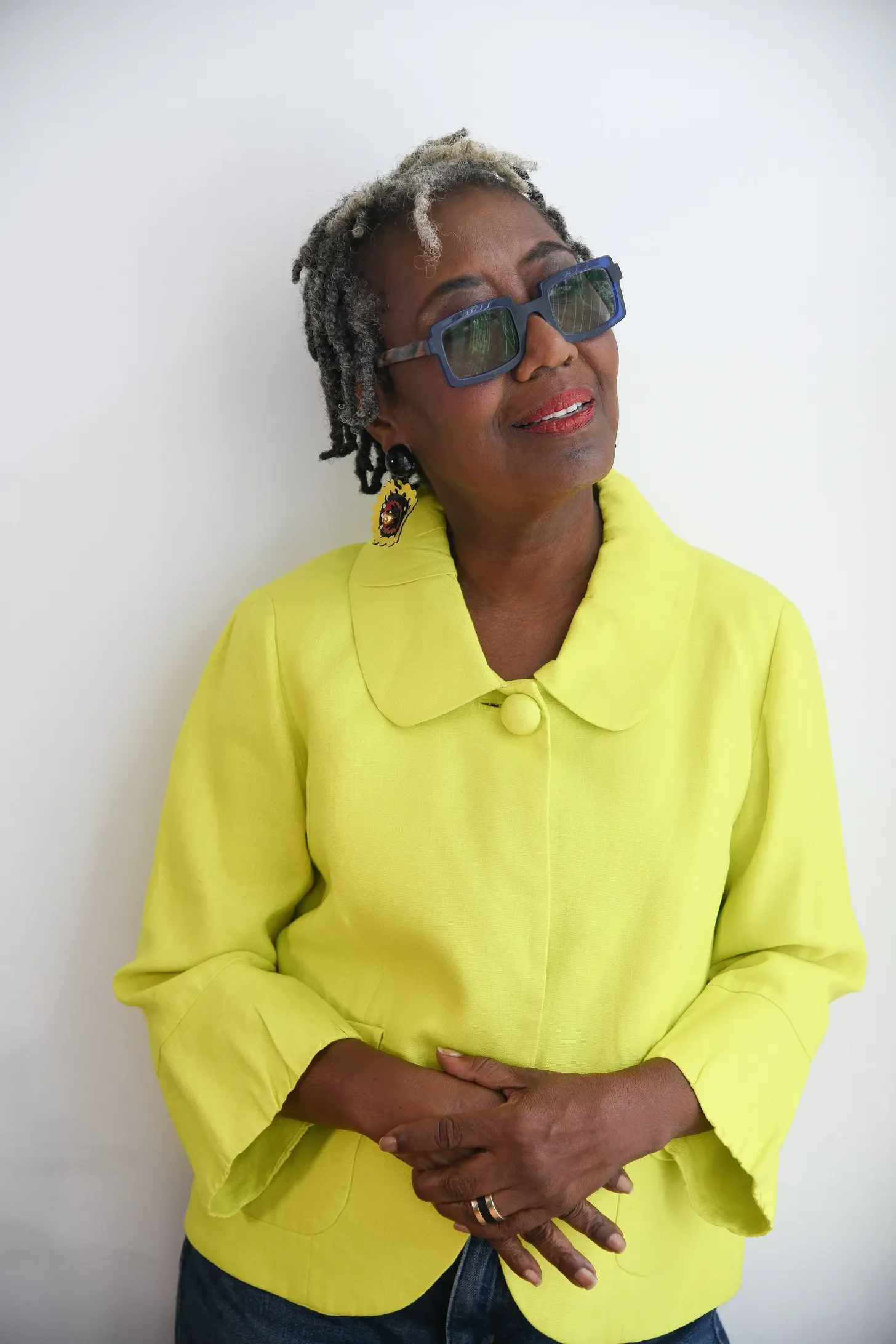
A conversation with Karen Outen by Bernadine (Dine) Watson
Dixon, Descending, by Karen Outen, is the arresting novel of twobrothers, Nate and Dixon, who decide to climb Mt. Everest in an attempt to be the first Black American men to summit the mountain. This book is not just the story of the brothers’ climb, which alone is fascinating, but an exploration of the complex relationship between two brothers, their experiences as Black men, in this country and the world, and of what one brother discovers about himself as a result of the climb. I found Dixon, Descending to be the most profound contemporary story about Black men that I’ve read. I encourage everyone to read it.
Dine: There is so much to talk about with this book. First, I want to ask you about your background as a writer. You’re a beautiful writer. How did you come to the writing life? Do you make your living as a writer, now?
Karen: Thank you so much for that compliment, Dine. I don’t remember a time when I didn’t write. Even in elementary school, I scribbled poems. My first short story was published in Essence in 1984, and I’ve published short stories and essays over the years. It took me 40 years to finally write a successful novel, however. Lots of discarded manuscripts in my file drawers. As an adult, I’ve nearly always had a full-time job working for educational nonprofits and colleges as a writer and editor, breaking that up with short stints as a freelancer and a college writing professor.
Dine: Dixon, Descending is one of four finalists for the 2025 Mark Twain American Voice in Literature Award. That’s a huge accomplishment. How does that make you feel as a writer? Has the award changed anything about your writing life?
Karen: I have to tell you, I was stunned! It’s so gratifying. Look, I’ve been writing for 40 years, mostly as an “emerging” writer—meaning, I just wasn’t there yet, wherever “there” is. This book took 15 years to write, too many drafts to recall, and lots of wondering along the way whether I was wasting my life by devoting so much of it to a writing goal that seemed to elude me. So, this nomination was just the loveliest confirmation that I was on the right track.
Dine: Now, the question you must get asked a lot: why write a story about Black men climbing Mt. Everest? As one of your characters asked (and this was an underlying theme throughout the book), what Black man wants to climb a cold ass mountain? Aren’t our lives hard enough? Are you interested in mountain climbing? Do you know Black climbers?
Karen Well, I wondered too: Who climbs Mt. Everest? And what Black man does this? Those questions compelled me. I don’t know any Black climbers and have only met by phone a couple of male climbers who were generous enough to answer my questions. Dixon just appeared to me one day after a long, hard stretch with my writing. I had written a previous novel, gotten a big-time agent, and been rejected left and right by publishers. I felt so dejected. And then one day, Dixon appeared in my consciousness. I saw him standing in front of the middle school where he worked and he was gaunt and limping. Who was this character? What had happened to him? As I explored, he revealed to me that he had just come back from Mt. Everest, and it had not gone well. I thought, what? Who does this? So that’s what led me to Everest, the very improbability of it.
Dine: You did a great deal of research for this book. The detail about mountain climbing— the preparation involved, the descriptions of Kathmandu and Nepal, the other climbers, the weather, the mountain and climb itself, are so vivid. What was your research process? How long did it take you to research the book?
Karen: You know, the Everest portions of the book were, in many ways, the easier parts. It was all so unknown to me that I just absorbed everything I could: movies, books, blogs, photos, interviews. I discovered along the way that I did know people who climbed—not Everest, but smaller mountains—and even some who had trekked to Everest Base Camp, and they became invaluable resources. I went away to an awesome writing retreat, Hedgebrook, for a few weeks and wrote the whole of the Everest sections there in the shadow of Mt. Rainier, which became a muse for me. Being away was so key to immersing myself in the feeling of Everest.
The most amazing thing about the research was that it transformed me. I started out thinking I’d never understand why somebody would climb mountains and wondering if it wasn’t just an ego-driven activity—a little arrogant of me, I’ll admit. But I just didn’t understand how real alpinists approach the business of climbing. They are out for a good experience of the mountain, it was explained to me, and they understand they may not reach the summit but that that’s part of the process of climbing, of being on the mountain. That really resonated with me as a writer because our work is so informed by failure. You never know if a story will work until you try it, and then you never know what that particular failure will lead to. You just hope those failures teach you something. It really opened me to the idea of approaching writing with a more open heart, understanding it’s about the journey. I came to have deep appreciation and respect for alpinists.
Dine: You also write in detail about Black middle-class life. Your descriptions of the Bryant brothers’ home, family, and way of life are spot on (the way the house is decorated, the parents’ way of entertaining, the mother’s jewelry, etc.) Why did you make the family middle class? Also, while the Bryants are a middle-class family, the brothers/family are well aware of their Blackness and what that means for them in the world. Was it important to you that the brothers/family have this race consciousness?
Karen: It was really important to me that I tell the story based in a Black middle-class identity. I didn’t see those stories enough growing up, and I often felt silenced by that absence, as if the presumption was that you couldn’t be both middle class and strongly Black identified. I knew from my own life that was not the case. There’ssuch a rich history of those preachers-teachers-social workers in our communities who are educated, who have some financial stability even though they are far from rich, and who are very proudly Black. I wanted to celebrate their lives.
Dine: I’m struck by the way you relate the concept of having “space” as a child to being “privileged.” The discussion between Shiloh (the troubled boy in the book) and Dixon about the amount of “space” they’d been allotted in life (Dixon having grown up in a “big” house, with a “big yard, his own bedroom and cross-country travel with his family and Shiloh having nothing close to that) is so poignant. Are you saying something to the reader about the importance of “space” in children’s lives?
Karen: Oh, that’s an interesting question. Yes, I think I am. I remember as a kid driving for the first time across country with my family. We were from Philly, living in typical rowhouses, seeing not stars at night but the hazy glow of city lights overhead, until we moved to Nashville when I was ten and lived on an acre of land at the edge of the city. But even in Philly, we lived in the parsonage of my dad’s church, which had a big block-wide backyard adjacent to it. I understood even as a little kid that that space was privilege. It meant my 20-plus cousins and I could have big birthday parties and run all through the yard and climb trees and act like country children in the middle of North Philly. I also spent a good deal of time with relatives on the Eastern Shore of Maryland, where spaces seemed wide and the nights so dark and full of stars. But not until we drove across country when I was thirteen did I understand the true vastness of space. West of Chicago, the world opened into nothing I’d ever seen before. Prairies. Mountains. Miles and miles between towns. The world was just waiting like an open hand. It seemed so full of possibility that it was nearly sacred. I can’t quite describe it. I can feel it even now, something both humbling and boundless about all that wide open space. I remember wondering why every kid in Philly couldn’t have a piece of this and how it would change them. I do think you can be changed by having the physical space to wander, to think, to just be, and to explore your connection to that openness.
Dine: The brothers’ mother and father seem to have different goals for their sons. The father’s goals seem to be respectability, and self -sufficiency. He wants his sons to be suit wearing men. The mother tells her sons (especially Dixon) to fly, to “stretch yourself.” Talk about why you draw the mother and father this way.
Karen: It seemed a reflection of the way I saw the parents, what they brought to the world and their hopes for themselves. I saw the father as having had more struggle to build his life than the mother had, so their aspirations for the children reflected their extended hopes for themselves. But ultimately, I think it was born of the same thing, the age-old question: how do we push them beyond where we are, how do they do even better than we have?
Dine: Despite their differences and competitiveness, Dixon and Nate clearly love each other. Why is there so much tension between them?
Karen: Oh, I think siblings that close in age naturally have a push-pull thing. I also think that Nate and Dixon’s status within their family creates that tension. Nate’s been used to getting away with a good deal, while Dixon’s the standard bearer, but those are imposed roles. They are close enough to see other aspects of each other’s personalities, the hidden things that they want to bring out in each other. That’s the tension, I think, that each wants the other to rise to a new level.
Dine: Why do you make Nathan the one to push the idea of climbing Everest, even though Dixon is the true athlete and climber?
Karen: This speaks to the previous question about the tension between them and their imposed roles in the family structure. I think Nate wants Everest for Dixon as much as, if not more than, he wants it for himself, and he knows only Dixon can push him enough to get there. He also imagines it as this triumphant thing that the two of them can do together, and it’s a proving ground for Nate. He seemed to have things come easily to him. He wants to show Dixon he can really do hard work. Perhaps ultimately Nate wants to rise to the vision he knows Dixon holds of him.
Dine: You show us so many sides of Dixon— the dutiful obedient son and good boy, the child psychologist and caretaker of young Black boys, his brother’s caretaker. But you also show us the ambitious, angry, prideful, even violent Dixon. Why is it important for us to see 360 degrees of Dixon?
Karen: I think we see what Dixon is discovering about himself. He’s been groomed to be patient and caretaking, but that’s just not his whole story. Throughout the book, Dixon reckons with these other sides of himself, especially his ambition and desire, which frighten him, and change his life, particularly on the mountain. So, how does he live now that those darker aspects of himself have been revealed?
Dine: Why is Dixon drawn to the boys, Marcus, and Shiloh? Why does Dixon continue to pursue Shiloh despite the boy’s repugnant behavior toward him?
Shiloh. Wow. He was supposed to have one scene in the book, but he just wouldn’t go away. I realized I had things to learn from that character, and consequently, so did Dixon. The relationship with Shiloh is key because in this story, you can’t always save the “right” person; you must deal with what’s left behind. He wants to rescueMarcus, a lovable easygoing kid, but the one who is in his face is Shiloh the unlovable. How do we embrace or reject the unlovable among us? Our response reveals so much about us, and this book is about Dixon being revealed to himself.
Dine: What does Dixon learn from Herbert, the cook at the diner where Dixon goes to work after the climb?
I loved Herbert. He was the guardrail for Dixon in his new life. Dixon had always functioned as part of a team, the younger if more responsible brother, so I knew he would need to be connected to someone in that same way. Herbert just filled that role, and what connected them was sorrow. I see them both as grieving for choices they’d made in the past and struggling to understand themselves as men. I think they heal each other by being able to reveal their pain. I found in writing the two of them a real beauty in the connection of these men who might never have met otherwise.
Dine: There is a quote at the beginning of the book that says about Everest, “the mountain doesn’t care whether we’re here or not….. It’s only what the mountain reveals about us that has lasting value.” What did the mountain reveal about Dixon? About Nate?
Karen: Oh, you have to read the book for that! Well, a lot of what the mountain reveals about any climber involves endurance. Not just physical but mental endurance. Can you withstand the suffering and loneliness? Despite being with a team, you really are alone with your own thoughts, your own doubts, and fears about yourself, and you must grapple with your desire for the mountain and for what it represents to you. It’s not for the weak, I’ll say that.
It took two readings of this book for me to fully understand what I think is the meaning of the book’s title. What does the title mean to you as the author?
Oh! You mean that comma. I felt like the book explores Dixon’s life in descent, which coincidentally is the most dangerous part of the climbing journey. The descent from a mountain is when most deaths occur, as people are exhausted and make poor choices after prolonged oxygen deprivation. As a result of his climb, Dixon is descending both from the physical mountain and from what he’s discovered about himself on the climb. More importantly, he is reckoning with—or descending from—his own lofty ideas of who he really is.
Dixon, Descending by Karen Outen was published in February 2025 by Dutton.